Reviewed · PRIVATE
Private Tour 3-Days in Cairo, Giza & Luxor
Egypt’s greatest sights come in one tightly packed package here: the pyramids at Dahshur, Saqqara, and Giza, followed by an ambitious day in Luxor. You get a private Egyptologist, air-conditioned transport, hotel pickup, three lunches, and flights to Luxor, so the tour removes much of the planning work.
I especially like the chance to see the Red and Bent Pyramids before reaching the famous Giza plateau, and I like the personal approach of a private guide. Guides named Hala, Muhammad Raki, Sugar Queen, and Mark have been praised for lively explanations, good English, and patience with questions. The main caution is pace: Luxor is a 12-hour day, and the whole three-day plan leaves little room for a slow morning.
At a glance: the details that matter
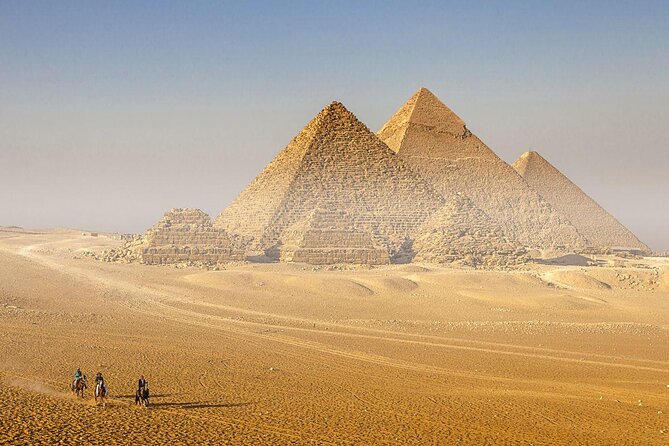
- Three pyramid sites in one day: Dahshur, Saqqara, and Giza give you a useful sequence from early pyramid design to the famous royal monuments.
- Private guiding: Only your group takes part, with an Egyptologist explaining the sites and adjusting the conversation to your questions.
- A full Luxor circuit: Karnak, Hatshepsut’s temple, the Valley of the Kings, Luxor Temple, and the Colossi of Memnon are covered in one day.
- Flights save road time: You fly between Cairo and Luxor instead of spending the day on a long overland journey.
- Meals and admissions are included: Three lunches, snacks, entrance fees, transport, and hotel transfers are part of the package.
- No hotel is provided: The $1,000 per-person price covers the touring program, not accommodation.
Day one, from Snefru’s pyramids to the Great Sphinx
The first day begins at 7:00 a.m. with hotel pickup. You travel in an air-conditioned vehicle to Dahshur, south of central Cairo, where the monuments feel more open and less compressed than the famous Giza plateau.
A few more days out in Giza to weigh up
- Cairo: Pyramids & Great Sphinx Private Tour with Camel Ride
★ 4.9 · 6,335 reviews - Tour to Giza Pyramids and The Egyptian Museum
★ 5.0 · 6,016 reviews - From Hurghada: Cairo and Giza Highlights Full-Day Tour
★ 4.5 · 6,014 reviews
Dahshur and the first true pyramid
Dahshur gives you a helpful introduction to pyramid building. The Red Pyramid is described as the first true pyramid, while the Bent Pyramid records an earlier attempt to solve the same engineering problem. Both were built for King Snefru, father of Khufu and founder of Egypt’s Fourth Dynasty.
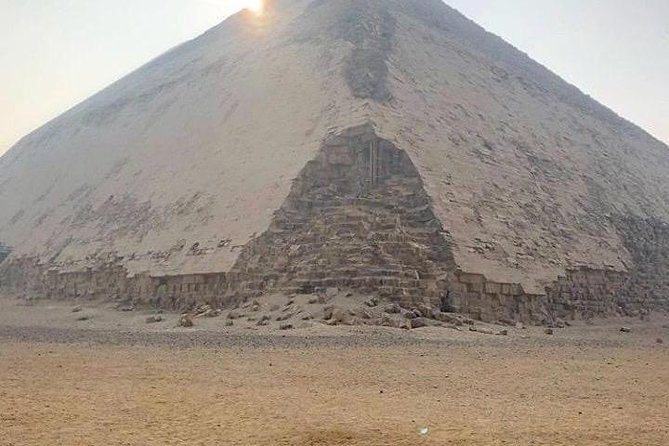
The Bent Pyramid is especially interesting because of its unusual change in angle. The lower section rises steeply, then the sides turn inward near the top. It is not simply an odd-looking monument. It shows builders adjusting their design as they learned how to create a stable, straight-sided pyramid.
The tour allows about two hours here, and admission is included. The Bent Pyramid reopened to visitors in 2019 after restoration work, so this stop offers something different from the better-known monuments at Giza. If you want the most famous postcard view, Dahshur is not it. If you want to see how the pyramid form developed, it is one of the most useful stops of the day.
Saqqara and the Step Pyramid complex
At Saqqara, you move further back in the story to the Step Pyramid of King Djoser. It is described as the oldest complete building made of stone, and its stacked design looks very different from the smooth pyramids built later.
The wider complex also includes the Pyramid of Unas, noted for the pyramid texts inside, the causeway of Unas, the Pyramid of Userkaf, and the Pyramid of Teti. Teti’s pyramid can be entered and includes pyramid texts. You also visit the tomb of Kagemni, an Old Kingdom nobleman associated with about 2200 BC.
This is where a private Egyptologist can make a real difference. Without explanation, Saqqara can feel like a spread of ruins and low walls. With a guide, you can connect the buildings, tombs, inscriptions, and changing royal designs. A guide who explains by sketching, as one guide named Sugar Queen has done for visitors, may be especially helpful when the monuments are hard to picture from the remains.
Plan on two hours, but do not expect to study every monument in equal detail. The itinerary covers a great deal of ground before lunch, and the day continues to Giza.
Giza, the Sphinx, and the Valley Temple
The Giza stop brings you to the pyramids of Cheops, Chephren, and Mycerinus. These are the monuments most people picture when they think of Egypt, but seeing them after Dahshur and Saqqara gives you a better sense of how the royal pyramid tradition developed.
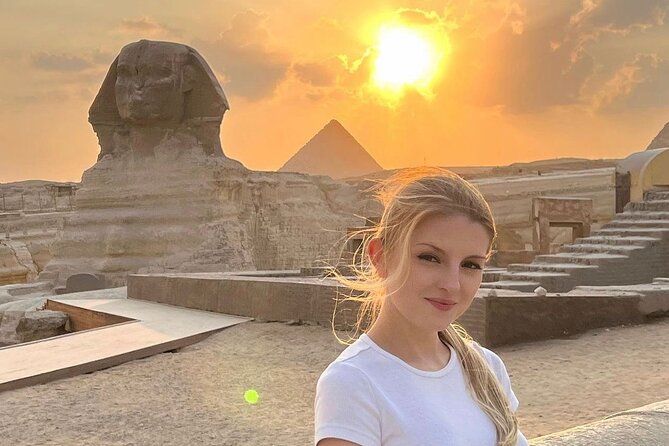
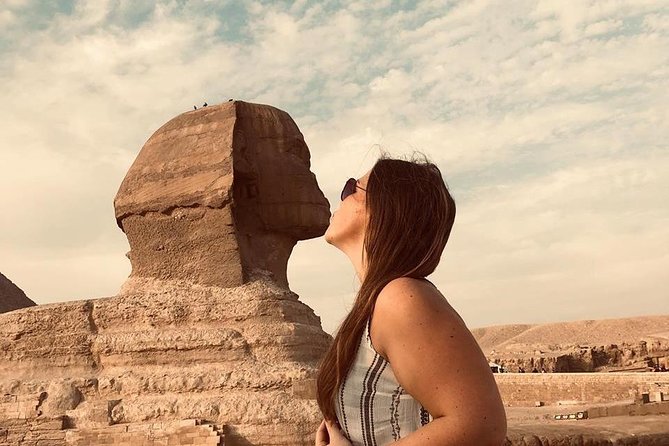
You also visit the Valley Temple, where the king’s body was prepared for mummification, and the Great Sphinx. The Sphinx is linked here with the reign of Chephren and dates to about 2550 BC. Your guide can help separate the individual pyramids and explain the purpose of the temple and Sphinx instead of reducing the visit to photographs.
The official stop lasts about two hours, followed by lunch at a local restaurant and transfer back to your hotel. Two hours is enough for a guided introduction and photographs, but it is not an unhurried exploration of every viewpoint. If entering a pyramid is important to you, ask about that before booking, since the supplied tour details include entrance fees but do not specify interior access for every pyramid.
A completely different sort of day in Giza:
- VIP All inclusive Best of the best Giza Pyramids,Sakkara,Memphis
★ 5.0 · 3,164 reviews - From Cairo: Pyramids of Giza, Sphinx, Saqqara & Memphis Tour
★ 4.7 · 3,110 reviews - Cairo 8 Hour Private Tour of Pyramids, Egyptian Museum and Bazaar
★ 5.0 · 2,931 reviews - From Cairo: Half-Day Tour to Pyramids of Giza and the Sphinx
★ 4.6 · 2,891 reviews
Day two, mummies, churches, mosques, and Cairo’s old market
Day two shifts from the ancient royal cemeteries to the city’s museums and religious quarters. The day is divided into four stops, with two hours at the Egyptian Museum, two hours in Coptic Cairo, one hour at the Citadel, and two hours at Khan Al-Khalili.
The Egyptian Museum’s most memorable rooms
Your guide meets you at the hotel and takes you to the Egyptian Museum. The visit includes the Animal Mummy Room, mummy portraits, and King Tutankhamen’s jewelry.
That selection gives you three different ways to understand ancient Egyptian life. Animal mummies reveal religious practice beyond royal burials. Mummy portraits bring individual faces into view. Tutankhamen’s jewelry provides the visual impact most people expect from a major Egyptian collection.
Two hours is a reasonable museum visit for a first look, though it will not cover every gallery. The value of the guide is in choosing a clear path and explaining what you are seeing. Hala has been praised for making Egyptian history easy to follow, while Muhammad Raki has been described as someone who connects ancient culture with contemporary Arab life. Guide assignments can change, so treat those names as possibilities rather than a guarantee.
Coptic Cairo and the Holy Family tradition
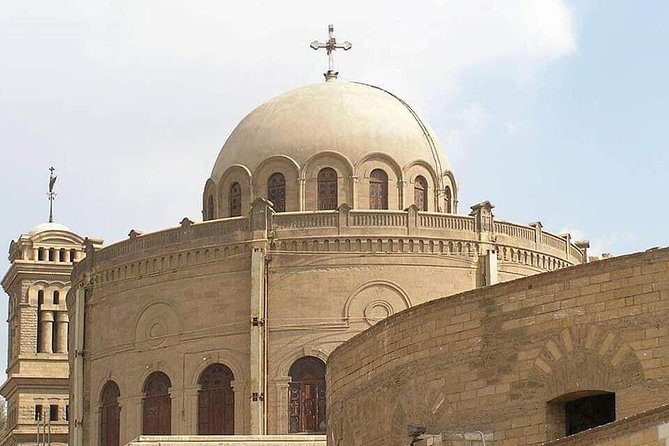
Coptic Cairo offers a different side of the city. You visit the Roman Fortress of Babylon, the Hanging Church, the Church of Abu Serga, the Ben Ezra Synagogue, and Saint George Church. The program also includes the cave associated with the Holy Family’s stay in Cairo.
This is a compact area with layers of Roman, Christian, and Jewish history close together. The churches are not simply decorative stops. Their importance comes from their place in Cairo’s long religious story and from the way older structures were reused and preserved.
The two-hour visit should give you time to see the principal sights with context. I would listen closely to the guide here, since the names and traditions can blur together when several churches are visited in one walk. The private format helps because you can stop and ask for the background you find most interesting.
Saladin’s Citadel and the Mosque of Muhammad Ali
The Citadel of Saladin provides a high view over Cairo, followed by a visit to the Mosque of Muhammad Ali Pasha. The mosque was built in 1848 and is known for its large scale and position at the top of the Citadel. Its design is described as a copy of Hagia Sophia in Istanbul.
The visit lasts about an hour, so expect a focused stop rather than a long architectural study. The panorama is a good counterpoint to the enclosed museum and churches earlier in the day. Inside the mosque, dress and behavior should be respectful. The guide can explain the building’s Ottoman influence and its place in Cairo’s skyline.
Khan Al-Khalili after dark or near day’s end
The final stop is Khan Al-Khalili, Cairo’s large historic market. Its foundation is linked to the Mamluk sultan Barquq and the 14th century. You have about two hours to walk through the lanes and browse.
This is the least scripted part of the tour. You can shop, look at the old urban fabric, or simply watch Cairo move around you. The market can also feel tiring after a full day, so do not feel obliged to buy anything. Your private guide can help you understand what you are seeing and make the visit less confusing.
The day ends with hotel drop-off. Guides praised in the feedback, including Hala and Sugar Queen, are often noted for their friendly manner and willingness to help beyond the basic sightseeing schedule. That matters on a day when you have spent hours moving between very different parts of Cairo.
Day three, the big Luxor circuit
The final day begins with airport transfer and a flight from Cairo to Luxor. On arrival, a guide meets you and takes you through the main monuments before returning you to the airport for the flight back to Cairo.
The entire Luxor program lasts about 12 hours. That makes the flight a smart use of time, but it also makes this the hardest day physically. You are not getting a relaxed Luxor stay. You are getting a concentrated look at the city’s major sights.
Karnak Temple and the Avenue of Sphinxes
Karnak is the first major Luxor stop. The program includes the Temple of Amun, the hypostyle hall, and the Avenue of Sphinxes.
The hypostyle hall is the place to pay attention to scale. Its forest of columns helps explain the power and ambition of the temple complex better than a quick exterior photograph can. A good Egyptologist will help you understand how the spaces were used and how the temple developed over time.
Queen Hatshepsut’s temple at Deir el-Bahari
Next comes the temple of Queen Hatshepsut, also called Deir el-Bahari. Its terraces and setting beneath the cliffs make it one of Luxor’s most distinctive monuments.
Hatshepsut’s story is worth hearing from a guide because the building reflects both religious purpose and royal identity. The stop is not only about the view. It also gives you a chance to learn about one of ancient Egypt’s most important female rulers.
The Valley of the Kings
The Valley of the Kings takes you into the burial zone used for pharaohs. The details provided for this tour do not state which individual tombs are included, and tomb access can depend on the ticket arrangement and current rules. Ask your guide on the day which entrances are available.
This is one point where expectations matter. The Valley is not a single monument with one doorway. It is a group of tombs, each with its own decoration and access rules. Your guide can help you use the available time well, but the tour does not promise access to every famous tomb.
Luxor Temple and the Colossi of Memnon
Luxor Temple is included later in the circuit, along with two statues of Memnon. The temple gives you another view of monumental religious architecture, while the statues provide a brief but memorable stop tied to the Theban royal zone.
Lunch is included before transfer to Luxor Airport. The return flight brings you back to Cairo the same day, avoiding an overnight stay and the long road journey between the two cities.
What the $1,000 price really covers
At $1,000 per person, this is not a low-cost sightseeing package. The value depends on how much you would otherwise spend arranging separate guides, entrance tickets, private transport, airport transfers, lunches, and Luxor flights.
Included are entrance fees, hotel pickup and drop-off, air-conditioned vehicle transport, a private tour, a qualified Egyptologist guide, snacks, three lunches, and the Luxor flight ticket. Accommodation is not included, so add your Cairo hotel costs separately.
For a couple or family, a private format can make the price easier to justify because you are not sharing the guide’s time with a large group. You also gain control over questions and conversation. Group discounts are offered, but the amount is not specified, so ask for the current rate before making a final decision.
The strongest value comes from the itinerary design. Dahshur, Saqqara, and Giza are combined efficiently, then Cairo’s museum and historic quarters are handled separately, and Luxor is reached by air. The tradeoff is that efficiency comes at the cost of spare time.
Who should book this three-day plan?
I would recommend it to a first-time visitor with only three days who wants the major ancient sites without arranging several separate services. It suits couples, families, and solo visitors who prefer a private guide and hotel-to-hotel transport.
It is also a good fit if you care about explanation rather than simply collecting photographs. Guides such as Hala, Muhammad Raki, Sugar Queen, and Mark have been praised for clear English, enthusiasm, humor, and the ability to answer questions. You can request a preferred guide, but availability is not confirmed in the supplied details.
I would hesitate if you want slow museum visits, long meals, or quiet time at each site. The Luxor day is especially demanding, and the first two days also cover a lot of ground. People with limited stamina should ask about the exact schedule and walking involved before paying.
Booking confirmation is provided at the time of purchase. Most people can take part, and only your group participates. Free cancellation is available until 24 hours before the start time. Cancellations or changes inside that window are not refunded, and poor weather may lead to a new date or a full refund.
My call: a strong shortcut with a demanding schedule
I would book this tour if my time in Egypt were short and I wanted the major Cairo and Luxor sights handled in one arrangement. The private Egyptologist and included flights remove two of the hardest planning jobs.
I would not book it expecting a leisurely archaeological holiday. You are buying access, structure, transport, and expert explanation, not empty space in the schedule. If you accept the early starts and the long Luxor day, this is a practical way to see an extraordinary amount of Egypt in three days.
FAQ
How long is the tour?
The tour lasts approximately three days.
What time does the tour start?
The stated start time is 7:00 a.m.
Is hotel pickup included?
Yes. Hotel pickup and drop-off are included.
Is accommodation included?
No. The tour price does not include accommodation.
Is this a private tour?
Yes. Only your group participates.
Is an Egyptologist guide included?
Yes. A qualified Egyptologist guide is included.
Which guides may lead the tour?
Guides named in the available information include Hala, Muhammad Raki, Sugar Queen, and Mark. The assigned guide is not guaranteed in advance.
Are flights to Luxor included?
Yes. The Luxor flight ticket is included, with a flight from Cairo to Luxor and a return flight to Cairo on day three.
Are meals included?
Yes. Lunch is included on all three days, and snacks are also included.
Can I cancel for a full refund?
Yes, if you cancel at least 24 hours before the experience start time. Cancellations within 24 hours are not refunded. If poor weather causes the tour to be canceled, you are offered another date or a full refund.
Just added in Giza
- Private Tour: Discover Giza Pyramids, Sphinx & Egyptian Museum★ 5.0 · 83 reviews
- Private pyramids tour to Giza pyramids Sphinx Dahshur Sakkara & Memphis★ 5.0 · 37 reviews
- GEM Grand Egyptian Museum Private Tour from Cairo Giza hotels★ 5.0 · 23 reviews
- Vip Tour Giza pyramids, sphinx with Camel Ride and Vip lunch★ 5.0 · 37 reviews
- 8-Hours Private Guided Tour in Giza , Egyptian Museum & Market with Lunch★ 5.0 · 21 reviews
- Giza Pyramids,Sphinx,Camel Ride,ATV Bike,Shopping,Dinner cruiseII★ 5.0 · 27 reviews
- Pyramids of Giza and National Museum Private Day Tour★ 5.0 · 21 reviews
- Private tour Giza Pyramids ,sphinx & camel ride all included★ 5.0 · 36 reviews
Private, compared.

Pyramids & Great Sphinx Private Tour with Camel Ride
Read our review →
Cairo 8 Hour Private Tour of Pyramids, Egyptian Museum and Bazaar
Read our review →
Private ViP all-inclusive Giza Pyramids,Sphinx,Inside Pyramid
Read our review →
Cairo Airport Private Arrival/Departure Transfer to any address/hotel in Cairo
Read our review →
Giza Pyramids and Sphinx: Half-Day Private or Group Tour
Read our review →
Private Full-Day Tour of Historical Alexandria
Read our review →
Best Private Giza Pyramids,Sphinx, New Grand Egyptian Museum
Read our review →