Reviewed · PRIVATE
Private Giza Pyramids & Sphinx Day Tour with Lunch from Cairo
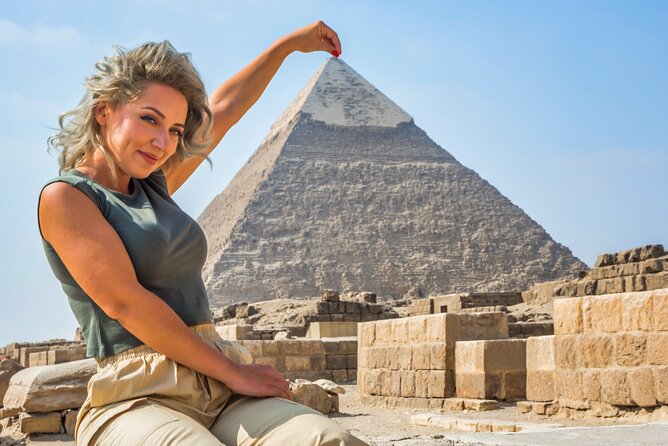
The best part of this half-day outing is simple: you get close to the Great Pyramid and Sphinx without having to manage Cairo traffic, taxis, and a huge ancient site on your own. A private guide takes you from your hotel to the Giza Plateau, explains the monuments, and returns you to Cairo or Giza.
I like the short, private format and the air-conditioned transport. I also like that the guide can help with photo spots, explain the Sphinx and valley temple, and shape the visit around your pace. Guides such as Eman Mostafa, Tito, Wael, and others have been praised for clear explanations and friendly service.
The main caution is that the tour details need checking before you pay. Basic area entry is included, but extra entrance fees, lunch, camel rides, and quad biking may depend on the option selected. Guide quality can also vary, so ask for a clear plan and the exact inclusions.
Key points to know before booking
- Private hotel pickup from Cairo or Giza keeps the morning simple and avoids arranging a separate ride to the plateau.
- The major Giza monuments fit into three to four hours, making this a useful choice during a short Cairo stay.
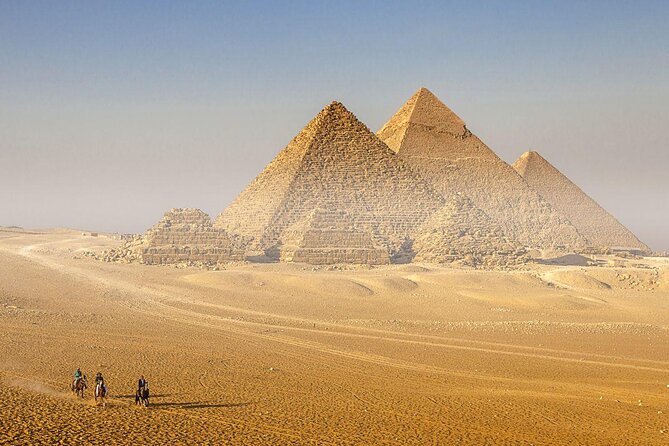
- Khufu, Khafre, Menkaure, the Sphinx, and the plateau viewpoint are all part of the planned visit.
- Lunch is not entirely clear in the booking details, so confirm if it is included in your selected option.
- Camel rides and one-hour quad-bike trips are optional, not part of the standard base experience.
- The private format gives you more control, but you should ask how much time you will have at each stop.
Why this short Giza tour works well
The pyramids are not a quick roadside photo stop. The Giza Plateau covers a large area, and the main monuments sit at different points around it. If you arrive without a plan, you can spend valuable time working out where to go, how to get between sites, and which entrance ticket covers what.
This tour handles the basic movement for you. Your guide collects you from a hotel in Cairo or Giza, and an air-conditioned vehicle takes you to the plateau. That matters most in the hotter months, when walking across open ground can become tiring well before you reach the Sphinx.
The private setup is another useful feature. You are not tied to the pace of a large coach group. You can spend more time on a favorite viewpoint, ask questions about the Old Kingdom, or move on when the site feels crowded or tiring. The published duration is about three to four hours, though one detailed experience ran closer to four or five hours with time for a camel ride and lunch.
At $35 per person, the price is attractive for a private half-day outing with transport and a local guide. Still, the low starting price should not be read as an all-inclusive cost. Basic entry is included, but optional site admissions and activities can add to the bill. Confirm the exact package before booking.
A few more days out in Giza to weigh up
- Cairo: Pyramids & Great Sphinx Private Tour with Camel Ride
★ 4.9 · 6,335 reviews - Tour to Giza Pyramids and The Egyptian Museum
★ 5.0 · 6,016 reviews - From Hurghada: Cairo and Giza Highlights Full-Day Tour
★ 4.5 · 6,014 reviews
Starting at the Giza Plateau
The first stop is the Giza pyramid complex, also called the Giza Necropolis. It contains the pyramids of Khufu, Khafre, and Menkaure, along with the Great Sphinx, temples, causeways, cemeteries, and remains connected with the workers who built and supported the complex.
The site was created during Egypt’s Fourth Dynasty, part of the Old Kingdom. The Great Pyramid and the Pyramid of Khafre are the two largest pyramids here, and seeing them together helps you understand the scale of the project. From a distance, the stones can look almost smooth and orderly. Up close, the size of each block and the steep rise of the sides make the construction feel far less abstract.
Your guide’s role is important here. A good explanation gives the site shape: which pyramid belonged to which ruler, how the temples and causeways connected, and why the plateau was arranged as a royal burial complex. The tour description promises an English-speaking local guide, but the amount of explanation can differ from one guide to another.
Ask at the start for a simple route and the time planned at each place. One concern with this type of visit is that the stops are listed in several separate blocks of about 30 minutes, yet the actual order and timing may change. A quick briefing helps you know when to linger and when to move.
Khufu, the Great Pyramid
Khufu’s pyramid is the monument most people picture when they think of Giza. It is the largest of the three main pyramids and the centerpiece of the plateau.
The visit gives you time to see the pyramid from close range and hear about its original complex. Khufu’s valley temple is now buried beneath the village of Nazlet el-Samman, while traces of paving and limestone walls have been found there. The causeway that once linked the valley temple with the upper complex was largely destroyed when the village grew around it.
That detail helps explain why Giza is not only a group of isolated pyramids. Each royal pyramid was part of a larger ceremonial system, with temples, processional routes, burial areas, and supporting buildings. You may not see every surviving fragment during a short tour, but the guide can help you picture the original layout.
Basic area admission is included according to the tour information, but access inside the pyramids may require an additional fee. The listing notes that entrance fees depend on the option chosen, so ask directly if you want to enter Khufu rather than only view it from outside.
The inside of a pyramid is not the right choice for everyone. The tour data does not describe the interior route or conditions, so confirm the ticket and practical details before committing. If you prefer open views and photographs, the outside visit may be enough.
Menkaure and the smaller southern pyramid
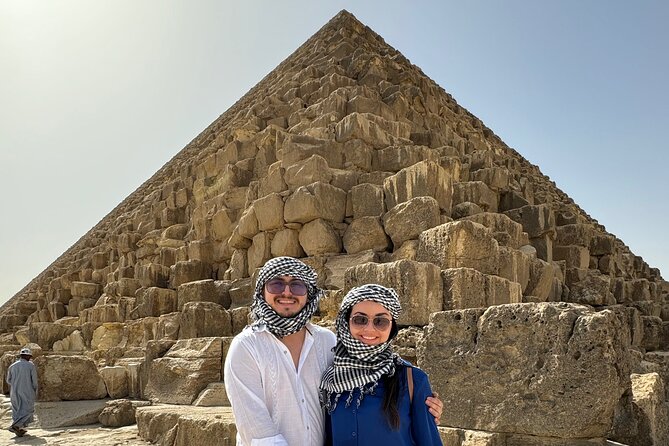
Menkaure’s Pyramid is smaller than Khufu and Khafre, but it completes the story of the three royal rulers. Its complex included a valley temple, causeway, mortuary temple, and the king’s pyramid.
The valley temple once held several statues of Menkaure. A smaller ante-temple was added during the Fifth Dynasty. Details like these are useful because they show that the pyramid complexes were not fixed the moment construction ended. Later rulers and priests continued to use, change, and maintain the site.
The planned stop lasts about 30 minutes. That is enough for an explanation, photographs, and a look at the pyramid, but it is not enough for a slow archaeological study. If Menkaure interests you most, tell your guide early. A private tour gives you a better chance of adjusting the pace than a large group excursion.
A completely different sort of day in Giza:
- VIP All inclusive Best of the best Giza Pyramids,Sakkara,Memphis
★ 5.0 · 3,164 reviews - From Cairo: Pyramids of Giza, Sphinx, Saqqara & Memphis Tour
★ 4.7 · 3,110 reviews - Cairo 8 Hour Private Tour of Pyramids, Egyptian Museum and Bazaar
★ 5.0 · 2,931 reviews - From Cairo: Half-Day Tour to Pyramids of Giza and the Sphinx
★ 4.6 · 2,891 reviews
Khafre and the surviving cap of stone
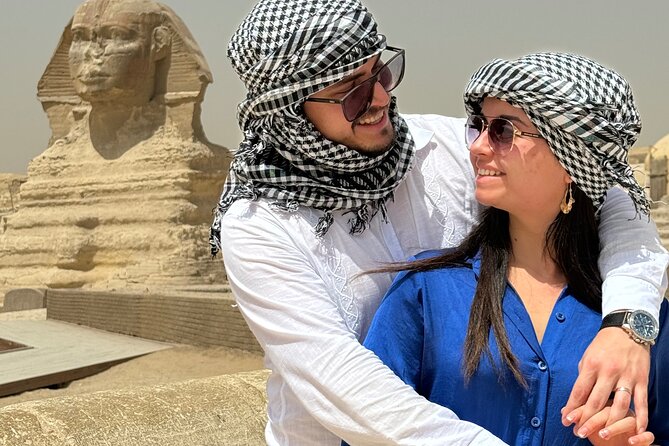
Khafre’s Pyramid often looks taller than Khufu’s because it sits on higher ground. It is also famous for retaining some of its original casing stones near the top, giving you a clearer idea of how the pyramids once appeared.
Khafre’s complex included a valley temple, Sphinx temple, causeway, mortuary temple, and royal pyramid. Several statues of Khafre were found in the valley temple, including discoveries made in the nineteenth century.
This is a good point to ask your guide how the pyramid, causeway, temple, and Sphinx fit together. The monuments make more sense when you see them as one connected royal complex rather than separate attractions.
Again, the scheduled time is around 30 minutes. That is practical for a half-day tour, but it can feel brisk if you want long photo stops at every monument. The private format helps, though your total time still depends on traffic, ticket arrangements, and the choices made during the outing.
Meeting the Great Sphinx
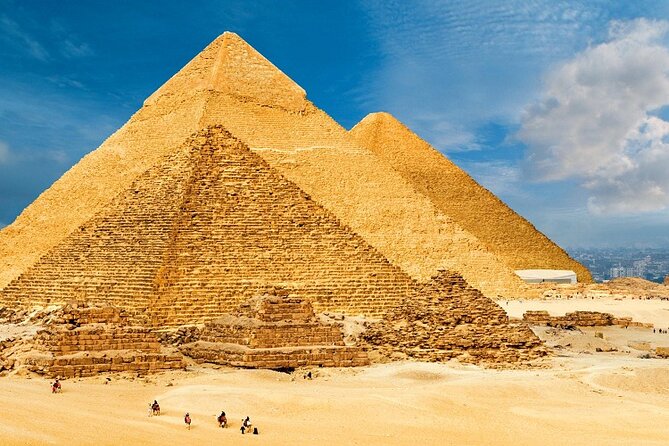
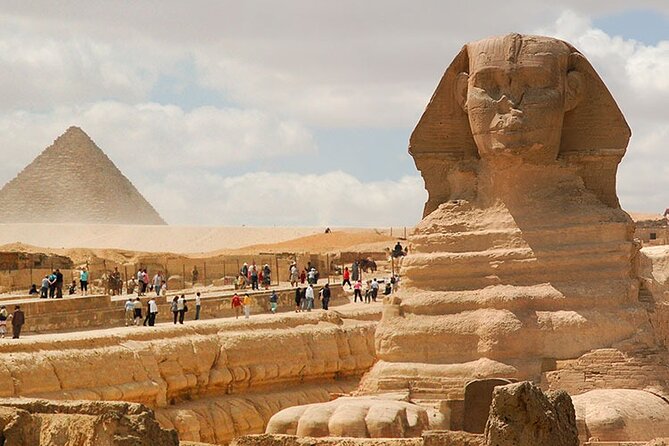
The Great Sphinx is one of the most memorable stops because it brings the royal and religious ideas of the plateau into one recognizable monument. The current Egyptological consensus identifies the head as Khafre’s, though your guide can explain the evidence and the questions that remain around its construction and use.
The Sphinx lies on the eastern side of the complex, near the temples connected with Khafre. From this area, you can see how the monument relates to the pyramid complex rather than treating it as a separate attraction.
The scheduled visit is about 30 minutes. That should give you time for close views and photographs, including the familiar front-facing angle. Guides can also help with photo positions, and this was one of the strongest practical benefits reported about the experience. Still, be clear about what you want: some people prefer historical explanation, while others mainly want time for photographs.
The Sphinx area can feel especially important after seeing the pyramids first. The change in scale and form gives the visit a different rhythm. You move from enormous geometric tombs to a single sculpted figure, partly cut from the bedrock.
The plateau viewpoint and photo time
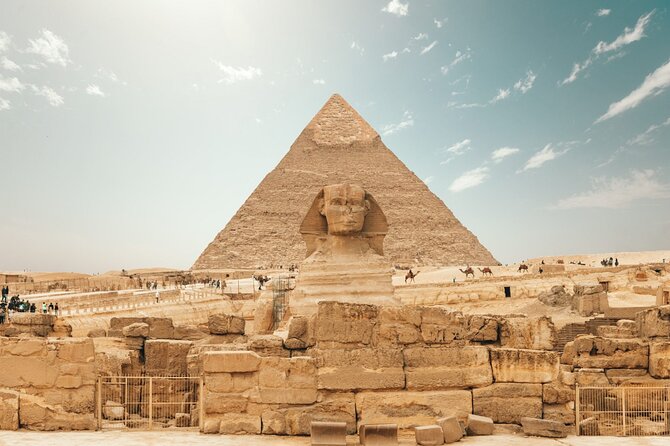
The panoramic viewpoint is designed for the broadest view of the three pyramids. From here, you can see the monuments together, which is difficult from ground level because each pyramid dominates its immediate surroundings.
This is the place for the classic group photograph and for noticing the way the pyramids occupy the edge of the desert. The viewpoint stop is listed at about 30 minutes. Bring water, use the time for photographs, and ask the guide to point out the position of each pyramid.
The tour includes bottled water, which is a small but useful touch in an exposed site. You should still dress for sun and heat, since the plateau has little shade and the tour involves outdoor stops.
The phrase panoramic view can mean different things on different visits. Ask your guide where the vehicle will stop and how much walking is involved. The supplied details confirm the viewpoint but do not give a precise path or surface conditions.
Lunch, camel rides, and optional extras
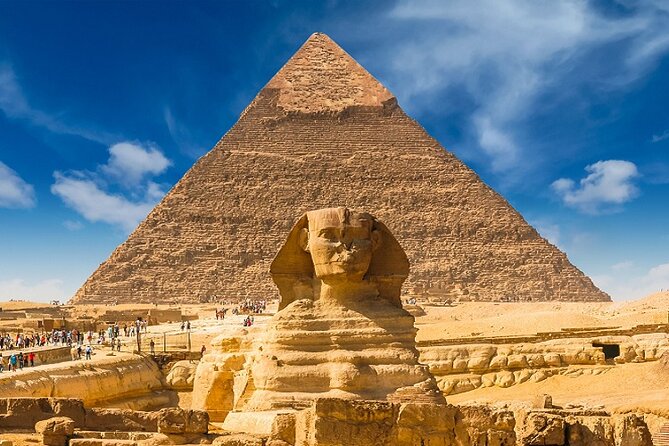
Lunch requires the most careful reading of the booking details. The headline says lunch is included, while the inclusions and exclusions describe lunch at a local restaurant serving koshari as optional. Treat this as an item to confirm before booking, not an assumption.
Koshari is a filling Egyptian dish made with ingredients such as rice, pasta, lentils, chickpeas, and tomato sauce. A local restaurant can make a practical stop after time in the sun, but the tour information does not name the restaurant or guarantee a particular menu.
A camel ride is also optional. One particularly full outing included a camel ride, lunch, and pyramid visits within roughly four to five hours. If you want this addition, agree on the price and duration before you start. The same applies to the optional one-hour quad-bike ride.
These extras can change the feel of the tour. A camel ride adds a traditional desert activity and extra photographs, while a quad-bike ride is more about speed and open terrain. Neither should be treated as part of the basic $35 package unless your selected option clearly says so.
Guide quality and the private format
The guide can make or break a short visit. You are seeing some of the world’s most famous monuments, but three hours is not long enough to read every sign or search out every detail. Clear explanations and good timing matter.
Several named guides received especially strong praise for their approach. Eman Mostafa was noted for detailed explanations of Egyptian history. Tito was praised for being friendly, polite, and attentive while sharing a large amount of information. Wael was described as easy to understand by a Japanese visitor, and Mohamed was identified as the driver.
These names show the kind of service you should hope for, but they do not guarantee who will be assigned to your booking. Guide assignment can vary. If you care about language clarity, history, or photography, say so when you book and repeat it at pickup.
The private arrangement also lets you ask basic questions without feeling rushed by a busload of people. You can ask your guide to explain the difference between a valley temple and a mortuary temple, or to repeat a point if the surrounding noise makes it hard to hear.
One weak point is that a quiet guide may give less explanation than you expect. If the commentary feels thin, ask direct questions. Tell the guide you want more history, a clearer route, or more time at a particular pyramid.
Transport, timing, and what to bring
Hotel pickup and drop-off are offered in Cairo or Giza. The air-conditioned vehicle is valuable because the plateau is exposed and Cairo traffic can be tiring. The tour is near public transportation, but the included pickup is the easier choice if you are staying in the city.
Plan for about three to four hours, with the possibility of a longer outing if you add lunch, a camel ride, or other activities. The published stop lengths add up quickly, so do not expect a full-day archaeological tour.
Bring water, sun protection, and comfortable shoes. Bottled water is included, but the supplied information does not specify how much is provided. You should also keep personal items secure, since they are not covered by the tour.
The mobile ticket and confirmation at booking make the arrangement straightforward. Free cancellation is available until 24 hours before the start time. Changes or cancellations made within that final 24-hour period are not accepted for a refund.
Who should book this Giza experience?
I would choose this tour if you have limited time in Cairo and want the main Giza sights without arranging transport yourself. It also suits first-time visitors who want a guide to explain the monuments instead of simply taking photographs and leaving.
Families and small private groups may like the flexible format. You can ask for breaks, adjust the photo time, and decide if a camel ride or lunch fits your day. The tour notes say most people can participate, though no detailed accessibility information is provided.
I would look elsewhere if you want a full archaeological study, extensive time inside the pyramids, or a clearly fixed lunch and ticket package. The short schedule covers the highlights, not every corner of the necropolis.
Should you book it?
Book this tour if easy transport, a private guide, and the major Giza monuments matter more to you than a long, highly specialized visit. The price offers good value when the base entry, hotel transfers, vehicle, guide, and water are included.
Before paying, confirm three things: which entrance fees are covered, whether lunch is included in your chosen option, and how much time you will have at each stop. If you do that, this is a practical way to meet Khufu, Khafre, Menkaure, the Sphinx, and the wide plateau view in one manageable Cairo outing.
FAQ
How long does the Giza tour last?
The tour lasts approximately three to four hours. An outing with additional activities such as lunch and a camel ride may take closer to four or five hours.
Does the tour include hotel pickup and drop-off?
Yes. Pickup and drop-off are offered from hotels in Cairo or Giza.
Is lunch included?
The tour information is inconsistent on this point. Lunch at a local restaurant serving koshari is described as optional in the inclusions and exclusions, so confirm what is included in your selected tour option.
Are entrance fees included?
Basic area admission is included, but additional entrance fees depend on the tour option chosen. Confirm the exact ticket coverage before booking, especially if you want to enter a pyramid.
Are camel rides included?
No. Camel rides are listed as optional and may cost extra.
Is quad biking part of the tour?
A one-hour quad-bike ride is listed as an optional activity. It is not part of the standard base experience unless your selected option specifically includes it.
Can I cancel for a full refund?
Yes, if you cancel at least 24 hours before the experience start time. Cancellations or changes made less than 24 hours before the start time are not accepted for a refund.
Just added in Giza
- Private Tour: Pyramids of Giza Memphis Saqqara with Lunch★ 5.0 · 85 reviews
- Private Pyramids, Saqqara and Memphis full day tour★ 5.0 · 15 reviews
- Pyramids, Sphinx, Memphis and Saqqara Full Day Private Tour★ 5.0 · 21 reviews
- Pyramids of Egypt full day tour: Great Pyramids of Giza, Saqqara & Memphis★ 5.0 · 36 reviews
- Private Tour to Great Pyramids of Giza and Sphinx★ 5.0 · 15 reviews
- Giza Pyramids & sphinx ,Saqqara(step pyramids,Dahshour (red and bent pyramids)★ 5.0 · 28 reviews
- Pyramids, Sphinx, Egyptian Museum And khan El Khalili Day Tour★ 5.0 · 25 reviews
- Full Day Guided tour to the Pyramids, Sphinx, Meidum And Dahshur★ 5.0 · 30 reviews
Private, compared.

Pyramids & Great Sphinx Private Tour with Camel Ride
Read our review →
Cairo 8 Hour Private Tour of Pyramids, Egyptian Museum and Bazaar
Read our review →
Private ViP all-inclusive Giza Pyramids,Sphinx,Inside Pyramid
Read our review →
Cairo Airport Private Arrival/Departure Transfer to any address/hotel in Cairo
Read our review →
Giza Pyramids and Sphinx: Half-Day Private or Group Tour
Read our review →
Private Full-Day Tour of Historical Alexandria
Read our review →
Best Private Giza Pyramids,Sphinx, New Grand Egyptian Museum
Read our review →