
Reviewed · EGYPT TOUR PACKAGES
2 Days 1 Night Travel Package To Aswan & Luxor From Cairo
Abu Simbel is the star of this two-day Cairo to Aswan and Luxor trip, but the route gives you much more: Philae on its relocated island, the Valley of the Kings, Hatshepsut’s temple, Karnak, and Luxor Temple. You cover a huge stretch of southern Egypt by air and road, with a private guide rather than a large group.
I like the private format, which lets your group travel with its own guide and vehicle. I also like that flights, airport transfers, entrance fees, and the major sightseeing are bundled into the $500 price. The trade-off is a punishing schedule, with a 3:00 am start, long road transfers, and no meals included.
Key points to know before booking
- Abu Simbel takes the first day’s biggest effort: The temples sit about 230 kilometers southwest of Aswan, so expect a long trip after your early flight.
- Philae was moved stone by stone: The temple now sits on Agilkia Island, protected from the rising waters created by the Aswan High Dam.
- Your second day is packed with ancient Egypt: The Valley of the Kings, Hatshepsut, the Colossi of Memnon, Luxor Temple, and Karnak all fit into one demanding day.
- The tour is private: Only your group participates, and a guide accompanies the sightseeing.
- Accommodation is optional: You can add the arranged bed-and-breakfast hotel or organize your own place in Aswan.
- Meals and gratuities are extra: Bring food money, water money, and a clear tipping plan.
Why this two-day route is so ambitious
This tour solves one of Egypt’s biggest travel problems: Cairo is far from the monuments of Upper Egypt. Instead of spending much of your holiday on trains or long-distance roads, you fly south, use local transfers, and return to Cairo from Luxor.
The price is $500 per person. That is not a bargain-basement day trip, but it covers round-trip domestic flights, transfers in Cairo, Aswan, and Luxor, entrance fees, and a private guide. If you tried to arrange each part separately, the value would depend heavily on the flight fare, hotel choice, and vehicle arrangements.
The main cost is not money. It is energy. You leave your Cairo hotel at about 3:00 am, fly to Aswan, visit several major sights, spend the night, and then spend the next day touring Luxor before flying back. You get a strong dose of ancient Egypt in two days, but you do not get much free time.
I would treat this as a focused monument tour, not a relaxed Nile holiday. It suits you best if your Cairo schedule is short, you want to see Abu Simbel, and you accept early mornings in exchange for covering a lot of ground.
More multi-day Egypt packages:
- Our Exceptional 5 days Cairo, Luxor and Abu Simbel Tour Package
★ 5.0 · 212 reviews - From Cairo: 8-Day Tour of Cairo, Luxor and Aswan with Cruise
★ 4.2 · 204 reviews - Private 9-Day Tour package to Cairo, Alexandria, Luxor, and Aswan by flight
★ 5.0 · 193 reviews
The 3:00 am Cairo pickup and flight south
The day begins before sunrise. A representative collects you from your Cairo hotel and takes you to Cairo International Airport for the flight to Aswan. Your booking requires a passport photo, and confirmation is subject to availability.
Flight information matters here. Make sure you have the correct departure details before the morning of travel. One account of the trip describes confusion over the flight information, with the airport pickup representative needing to call for clarification. That is an easy problem to avoid if you confirm the flight number and pickup time in advance.
Once you reach Aswan, the tour moves quickly. You are not arriving for a slow morning beside the Nile. The normal plan is to begin sightseeing soon after landing, with Abu Simbel included on the first day.
That tight timing explains why the experience can feel efficient and stressful at the same time. Transfers are included, but the schedule leaves little room for missed connections, long meals, or delays.
Philae Temple and the story of a rescued island
Philae is one of Aswan’s most memorable sites because the temple’s location is part of its story. The original complex sat near the First Cataract of the Nile, but repeated flooding from the Aswan Low Dam threatened the buildings.
During the UNESCO Nubia Campaign, the temple complex was dismantled and rebuilt on nearby Agilkia Island. The relocation protected the carvings and columns before completion of the Aswan High Dam in 1970. Your visit is therefore about both ancient worship and modern preservation.
Allow about three hours here, including the transfer to the island and time at the monument. The setting makes Philae feel different from the huge temple fields around Luxor. Water surrounds the island, and the temple arrives as a compact, carefully preserved complex rather than a broad city of ruins.
Your guide is important at Philae. Without context, the reliefs can look like a series of formal figures and symbols. With an Egyptologist explaining the gods, rulers, and later changes to the site, you can better understand why this temple remained important for so long.
The visit also gives you a useful introduction to the engineering story of southern Egypt. You see the result of a massive twentieth-century effort to save ancient monuments from a modern dam project.
The Aswan High Dam in 30 minutes
The High Dam visit is brief, listed at about 30 minutes, but it explains much of what you have just seen. The dam controls the Nile’s annual floods, reduces damage along the floodplain, improves navigation, and supplies about half of Egypt’s power.
You will not spend hours studying the structure. Instead, think of this as a short stop that connects modern Egypt with the flooding problems that affected Philae and the Nubian monuments.
The stop may feel less dramatic than the temples, especially after an early flight. Still, it gives the day a useful balance. Ancient Egypt is not the whole story in Aswan, and the dam changed how the river supports life in the country.
A few more days out in Luxor to weigh up
- Hurghada: 2-Day Luxor Tour with Hotel, Balloon, & Boat Ride
★ 4.5 · 1,113 reviews - 2-Day Top Attractions and Adventures Package in Luxor with Accommodation
★ 5.0 · 178 reviews - From Cairo: 2-Day Abu Simbel & Luxor Tour
★ 3.9 · 136 reviews - Hurghada: 2-Day Luxor Highlights & Hot Air Balloon & Hotel
★ 4.3 · 89 reviews
Abu Simbel, the first day’s main prize
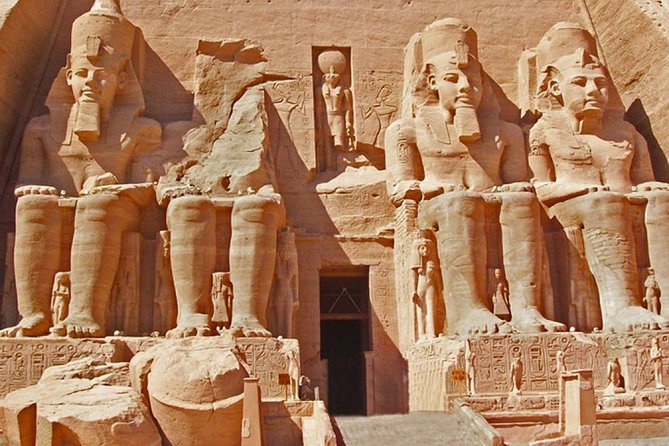
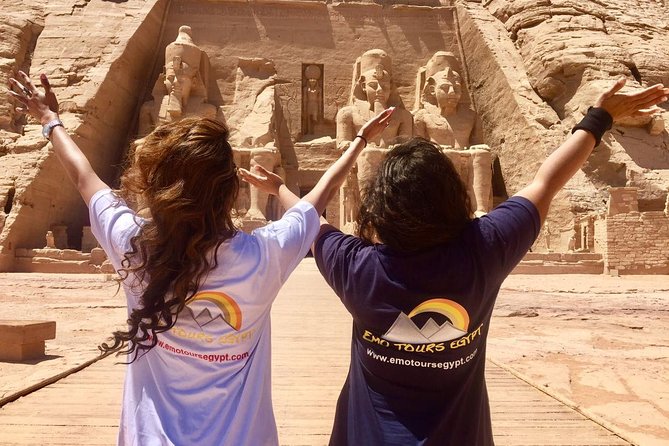
Abu Simbel is the reason many people accept this schedule. The two temples were carved into the mountainside during the reign of Ramesses II in the 13th century BC. Their enormous seated figures are among Egypt’s most recognizable monuments.
The larger temple honors Ramesses II and the gods, while the smaller temple was dedicated to his queen, Nefertari. The complex also commemorates Ramesses II’s victory at the Battle of Kadesh. You get roughly three hours at the site, with entrance included.
The journey is the issue. Abu Simbel lies about 230 kilometers southwest of Aswan, and the road journey is about 300 kilometers. After flying from Cairo and touring Philae and the dam, you may find the trip tiring. The reward is scale: the façades, carved figures, interior halls, and reliefs make a powerful impression even if you have already seen several temples.
Plan to carry food or buy it when a stop is available. Lunch and dinner are not included, and one guest found the first day especially difficult because no breakfast or lunch had been provided. You should not assume that a meal appears between the airport, the temples, and the road.
The guide can make a real difference here. Samir received especially strong praise for explaining Aswan and Abu Simbel and for arranging stops for food and souvenirs. That kind of practical help matters on a day when you are tired and unsure how much time remains before the next transfer.
Your Aswan night and the accommodation choice
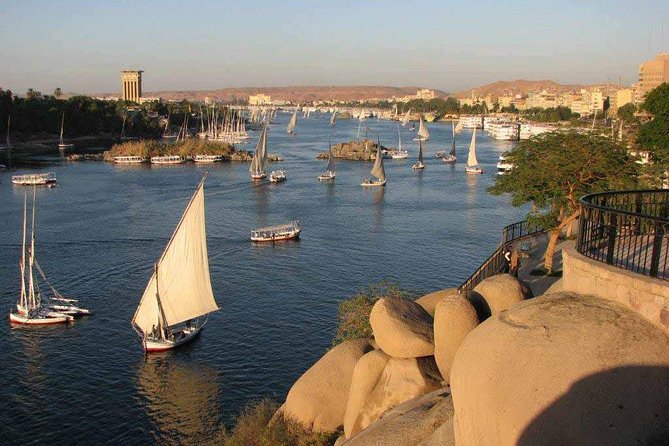
The package gives you a choice about the overnight stay. You can add a bed-and-breakfast hotel through the operator, or arrange your own accommodation. This flexibility may help you control the budget, but it also creates a detail you must settle clearly before departure.
If you book your own hotel, confirm that the local team knows the address and the morning pickup plan. One successful arrangement involved a traveler staying at a self-booked Aswan hotel and being collected the next morning for the Luxor portion.
Room arrangements also deserve attention. A booking made for two friends resulted in one double room, and changing to separate rooms required an additional payment of almost $100. If you need twin beds or separate rooms, state that in writing before the trip and ask what extra charge applies.
You are paying for a fast sightseeing package, not a long hotel stay. Still, after the Abu Simbel road trip, a clean room and a straightforward breakfast can make the second day much easier.
The Valley of the Kings and the tomb choices
The second day begins in Luxor on the west bank of the Nile, in the Theban Necropolis. The Valley of the Kings served as a burial area for pharaohs and powerful nobles for almost 500 years, from the 16th to the 11th century BC.
The valley contains 63 known tombs and chambers, ranging from simple pits to large and complex burial spaces. Your included entrance covers the standard visit, but entering the tomb of King Tutankhamun is optional and costs extra.
Do not expect to see every tomb. The valley is a concentrated site, and the exact open tombs can vary. Your guide should help you understand the painted corridors, burial plans, and royal beliefs rather than simply rushing you from doorway to doorway.
Heat, uneven ground, and the early start can affect how long you want to stay inside each tomb. Bring water and wear practical shoes. Since the tour already includes several more sites, you will need to pace yourself.
King Tutankhamun’s tomb is famous, but the optional charge does not automatically make it the most important stop. Decide based on your interest and budget. The included visit already gives you access to the main valley experience.
Hatshepsut’s temple under the cliffs
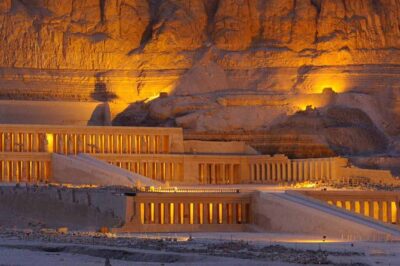
The Temple of Hatshepsut at Deir el-Bahari is about two hours on the schedule. Its terraces rise beneath the cliffs on Luxor’s west bank, creating a strong contrast with the underground tombs you have just visited.
Hatshepsut was an Eighteenth Dynasty pharaoh, and the temple was dedicated to Amun and to her own royal cult. Its design uses broad levels and long lines that lead your eye toward the rock face behind it. Restoration continues under the Polish Academy of Sciences in Warsaw, so some sections look more complete than others.
This is one of the stops where a guide’s explanation helps you read the site. Hatshepsut’s reign, royal imagery, and the temple’s later treatment are not obvious from the stone alone. Give yourself time to notice the relationship between the terraces, columns, reliefs, and cliffs.
The site is open and exposed, so the combination of sun and fatigue can be harder than the visit suggests on paper. You will appreciate the two-hour allowance, but the schedule does not leave much room for lingering.
The Colossi of Memnon, a quick roadside stop
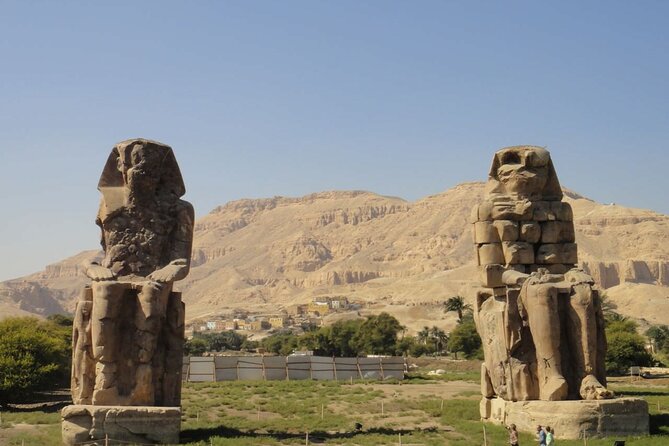
The Colossi of Memnon take about 30 minutes. These two huge stone statues represent Amenhotep III, who ruled during the Eighteenth Dynasty. They have faced the Nile from the west bank since about 1350 BC.
This is a short stop, but it breaks up the west-bank sightseeing. The statues are easy to grasp at a glance: two monumental figures, weathered by time, marking the remains of a once-important royal complex.
You should not expect a full temple visit here. The value is scale and setting, plus the chance to see one of Luxor’s best-known landmarks without spending another long block of time.
Luxor Temple after dark or before departure
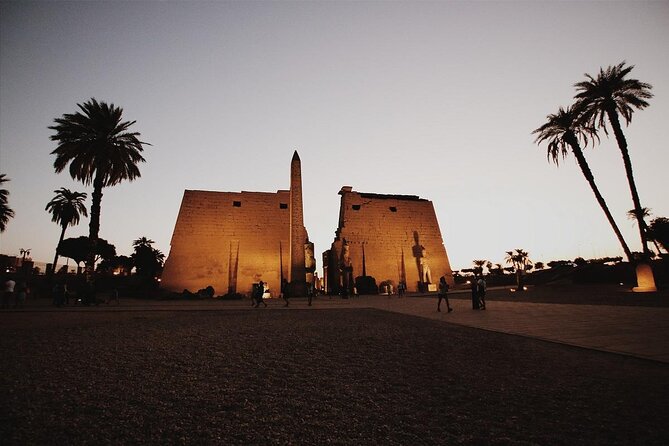
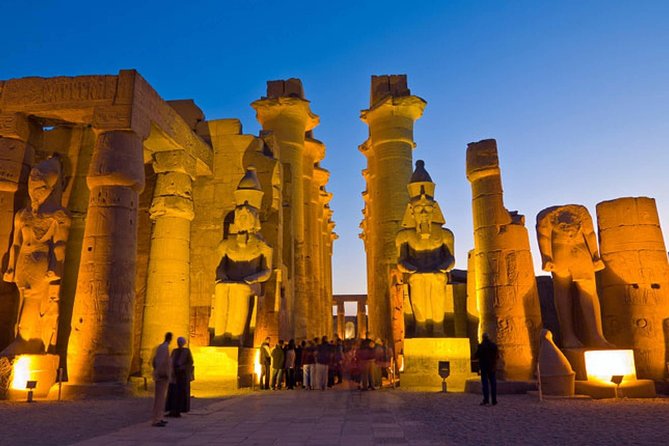
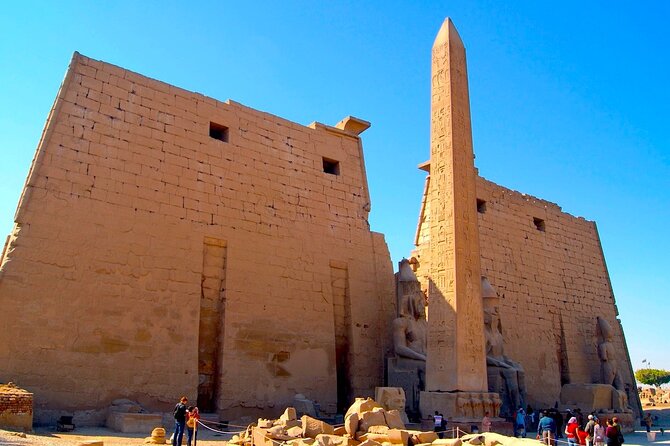
Luxor Temple is on the east bank and receives about two hours. Construction began around 1400 BC, and unlike many mortuary temples, it was not dedicated solely to a dead ruler. It was connected to a cult center and to the religious life of ancient Thebes.
The temple’s urban setting gives it a different feel from the west-bank monuments. You see how ancient religious buildings occupied the heart of Thebes, while the royal tombs and mortuary temples lay across the river.
Your guide can help you separate the work of different rulers and explain how the temple changed over time. The visit works well late in the itinerary because its major avenues, pylons, columns, and statues offer a final large-scale encounter before the airport transfer.
Keep an eye on the clock. The tour ends with a transfer to Luxor Airport for your flight back to Cairo and then transport to your hotel. A delayed visit or an overly long meal can create pressure on this final leg.
Karnak, the grand finale in Luxor
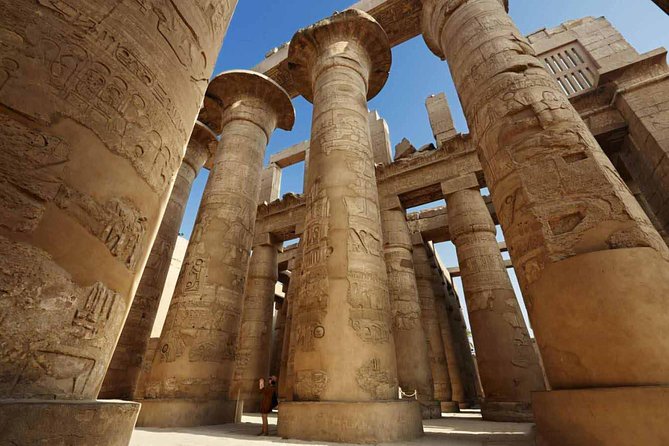
Karnak gets about two hours and is the largest site on the route. The complex includes temples, chapels, pylons, and other buildings developed over many centuries, from the Middle Kingdom into the Ptolemaic period.
Most of what you see dates from the New Kingdom. Karnak was the main worship center for the Theban Triad, with Amun at its head. Its scale can be difficult to absorb in a short visit, so follow your guide’s route and ask which areas best explain the complex.
Karnak rewards attention to detail. Look at the layers of construction, the huge columned spaces, and the way successive rulers added their own marks. You are not just visiting one temple, but a religious center that grew over a very long period.
The two-hour slot is enough for a strong introduction, not a complete study. If you want a slow, scholarly exploration of every chapel and inscription, this package will feel too fast. If you want the major spaces and a clear explanation of their purpose, it works.
Guide quality, private transport, and practical gaps
The experience is private, so your group does not share the tour with other participants. That gives you more direct access to the guide and avoids the stop-and-go rhythm of a large coach. It also means the quality of your assigned guide matters a great deal.
Samir is specifically associated with a strong first-day experience in Aswan and Abu Simbel. His ability to explain the sites and arrange food and souvenir stops is useful, though you should not assume that he will be your guide for every section.
Set expectations about tipping early. One person found the guide too forceful about tipping people he knew, while also disliking his frequent smoking. Tips are not included, so decide what you are comfortable giving and keep the decision yours.
Transfers are included in Cairo, Aswan, and Luxor. Still, airport handoffs need careful confirmation. A missed pickup for the Luxor airport transfer caused serious stress in one case, and a last-minute cancellation because flights were unavailable caused even greater disruption for another booking.
Because the tour starts at 3:00 am, a small communication problem can become a major one. Confirm the flight details, hotel address, pickup times, room arrangement, and meal plan before you leave Cairo.
Is $500 a fair price for this Egypt package?
The $500 price can be fair if you value convenience. You receive the flights between Cairo and southern Egypt, local transportation, entrance fees, a private guide, and the chance to see Abu Simbel, Aswan, and Luxor in only two days.
The price is less attractive if you expect a full-service holiday. Lunch and dinner are extra. Accommodation is optional. Tips are extra. King Tutankhamun’s tomb is extra. Add those costs before comparing the package with a longer organized tour or a self-arranged itinerary.
The biggest value is time. You avoid planning each transfer between airports, temples, and hotels. You also gain a guide who can put the monuments into historical context. The biggest sacrifice is rest.
Who should book this tour?
I would choose this tour if you have limited time in Egypt and consider Abu Simbel essential. It also suits you if you prefer a private arrangement and want flights rather than a long overland journey from Cairo.
I would be cautious if you need leisurely mornings, guaranteed meal service, separate hotel rooms, or a carefully paced visit at each monument. Families with young children and anyone sensitive to very early starts should think hard about the schedule.
The cancellation terms are strict close to departure: cancel at least six full days ahead for a full refund, two to six days ahead for a 50 percent refund, and less than two full days ahead with no refund. Given the flight dependence, I would not wait until the last minute to confirm every detail.
Final verdict: a powerful route with little spare energy
This package gives you an impressive list of southern Egypt’s essential monuments in a remarkably short time. Philae, Abu Simbel, the Valley of the Kings, Hatshepsut, Luxor Temple, and Karnak are worth the effort, and the private format plus included flights can make the $500 cost reasonable.
Book it if your priority is coverage and convenience. Skip it if your priority is rest, flexible meals, or long hours at each site. If you do book, confirm flights, pickup times, hotel arrangements, room type, and food plans in advance, then arrive ready for two intense days of ancient Egypt.
FAQ
How long is the experience?
The tour lasts approximately two days and includes one overnight stay.
What time does the tour start?
Pickup starts at approximately 3:00 am from your Cairo hotel.
Are flights included?
Yes. Round-trip flights from Cairo to Aswan and from Luxor back to Cairo are included.
Is the tour private?
Yes. This is a private activity, and only your group participates.
Which major sites are included?
The route includes Philae Temple, the Aswan High Dam, Abu Simbel, the Valley of the Kings, Hatshepsut’s temple, the Colossi of Memnon, Luxor Temple, and Karnak Temple.
Is hotel accommodation included?
Accommodation is optional. You can add a one-night bed-and-breakfast hotel or arrange your own accommodation.
Are meals included?
No. Lunch and dinner are not included. You should plan separately for meals during the two days.
Is King Tutankhamun’s tomb included?
No. Visiting King Tutankhamun’s tomb in the Valley of the Kings is an optional visit with an additional fee.
What is included besides the flights?
The package includes a tour guide, transfers in Cairo, Aswan, and Luxor, and entrance fees. Tips, meals, and optional visits are not included.
Just added in Luxor
- Private Trip To Luxor from Cairo by Plane★ 5.0 · 22 reviews
- Luxor Private Day Trip from Cairo by Plane★ 4.5 · 69 reviews
- Private Day Tour To Luxor from Cairo by Plane,Tours,Sailing Felucca,Camel&Lunch★ 5.0 · 45 reviews
- Private Day Tour To Luxor from Cairo by Plane★ 4.5 · 41 reviews
- Package 8 Days 7 Nights To Jewels of Egypt, Luxor & Aswan Tour★ 5.0 · 29 reviews
- Package Cairo & Alexandra & Luxor & Aswan★ 5.0 · 39 reviews
- Overnight Luxor Tours by train from Cairo with Hot Air Balloon and much more★ 5.0 · 29 reviews
- Private Luxor Day tour from Cairo by Flight★ 5.0 · 25 reviews
Egypt Tour Packages, compared.
6 Days Hypnotic Cairo & Nile Cruise Tour Package
Read our review →
Our Exceptional 5 days Cairo, Luxor and Abu Simbel Tour Package
Read our review →
8-Day Tour of Cairo, Luxor and Aswan with Cruise
Read our review →
Egypt on Budget – 8 Days ( Cairo , Aswan , Nile Cruise – Luxor ) Sleeper Train
Read our review →

8-Day Private Egypt Tour with Flights and Nile Cruise
Read our review →
Browse the lists this tour appears in