
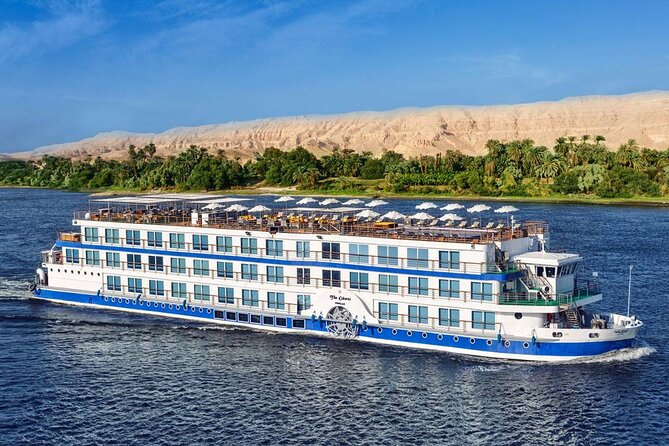
Reviewed · NILE CRUISES
4Day 3-Nights Nile Cruise From Aswan To Luxor
The best part of this four-day cruise is the steady rhythm of moving between Egypt’s great temples while the Nile slips past your window. You unpack once, eat aboard ship, and reach the major sights with an Egyptologist guide rather than trying to arrange separate taxis, tickets, and tours. Philae’s island setting and the grand temples at Edfu and Karnak give the trip real variety.
I like the practical all-in-one setup: three nights of five-star ship accommodation with full-board meals, plus air-conditioned pickup and drop-off. I also like the strong guiding at Edfu and Luxor, where the explanations help turn columns, gods, and royal tombs into a story you can follow. The main caution is the pace. Several major sites arrive close together, and the schedule has some unclear wording about the first morning and sailing times, so confirm the exact pickup and departure details before you go.
Key points to know before booking
- Three nights on the Nile: You cruise from Aswan to Luxor with breakfast, lunch, and dinner included during the cruise period.
- Major temples covered: The program includes Philae, Kom Ombo, Edfu, Luxor Temple, and Karnak, along with the West Bank sites.
- Egyptologist-led touring: A qualified guide accompanies the sightseeing at the historic sites.
- Private group format: Only your own group takes part in the activity.
- Optional add-ons: Abu Simbel, a Nubian village visit, and a hot-air balloon ride are not included in the listed price.
- $542.86 per person: The fare covers the cabin, meals, transfers, guides, entrance fees, and the three-night cruise, which makes it a useful package for a first Nile visit.
What $542.86 buys you on the Nile
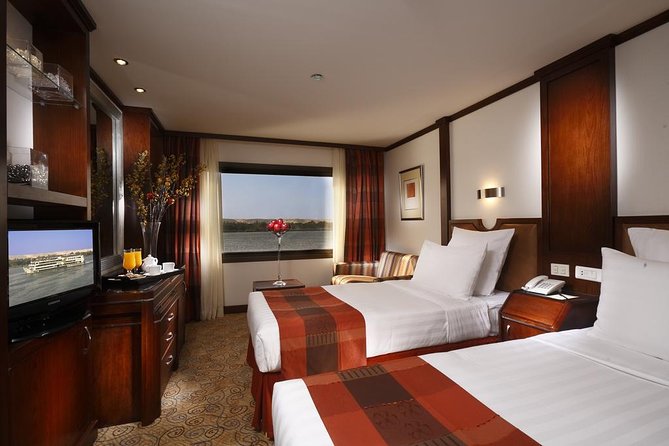
At $542.86 per person, this is not simply a boat ride with meals attached. The price includes three nights in a five-star cruise cabin, air-conditioned transport, entrance fees, a qualified Egyptology guide, and sightseeing in Aswan, Edfu, Kom Ombo, and Luxor.
That matters in Egypt, where separate entrance tickets and private transport can quickly add up. You also avoid changing hotels every night. Your cabin becomes your base while the ship moves south to north, and the river supplies the scenery between the monuments.
The fare includes lunch, dinner, and breakfast during the cruise, with meals beginning at lunch on the first day and ending with breakfast on the fourth day. Drinks are extra, as are gratuities and attractions not named in the program. Abu Simbel, the Nubian village, and the hot-air balloon ride each require separate payment if you choose them.
The word five-star describes the cruise category, but it does not tell you everything about the specific ship, cabin size, or onboard schedule. If those details matter to you, ask for the vessel name and cabin information before paying. The tour does promise air conditioning and a cabin with all facilities, which is important during a busy sightseeing program.
A few more days out in the Nile Valley to weigh up
- 4-Day 3-Night Nile Cruise from Aswan to Luxor&Abu Simbel+Balloon
★ 5.0 · 2,023 reviews - 4-Day 3-Night Nile Cruise from Aswan to Luxor including Abu Simbel, Air Balloon
★ 4.5 · 612 reviews - From Aswan: 4-Day Nile Cruise from Aswan to Luxor with Guide
★ 4.1 · 593 reviews
Aswan High Dam and Philae’s island temple
The first sightseeing day begins with the Aswan High Dam, a huge rock-fill structure built between 1960 and 1968 and officially opened in 1971. Its reservoir, Lake Nasser, reaches south toward Egypt’s border with Sudan. The dam changed how Egypt controlled the Nile and also led to the relocation of several ancient sites.
The visit is useful because it gives modern context to the monuments that follow. Ancient temples were not simply left in place when the dam was built. Some had to be moved to higher ground, and Philae is the most beautiful example of that effort.
Philae Temple is dedicated to Isis and now sits on an island setting arranged to resemble its original location. UNESCO helped move the complex when the rising waters threatened it. The result is a temple visit with an unusual sense of place: you reach the sanctuary by water, then walk among courtyards and carved walls surrounded by the Nile.
The listed visit lasts about an hour and a half. That is enough to see the main areas, but you will want to listen closely to the guide because the carvings can look similar at first glance. Your guide helps explain Isis, the temple rituals, and the relocation work without leaving you to guess what you are seeing.
Lunch is served aboard the ship, followed by sailing around Kitchener’s Island and the Agha Khan Mausoleum by felucca. The schedule also includes afternoon tea and dinner on board. These quieter hours are part of the appeal of a Nile cruise. Not every minute is spent walking over hot stone or studying temple walls.
The first day’s wording is slightly confusing. It refers to breakfast on board and arrival in Aswan, while the included meals say the program starts with lunch on the first day. Pickup arrangements and the exact start time should be confirmed before departure.
Kom Ombo and the overnight stop at Edfu
The ship continues toward Kom Ombo on the second day. The temple is unusual because it is a double temple, shared by Sobek, the crocodile-headed god, and Haroeris, the falcon-headed form of Horus.
That split dedication gives you an easy way to understand the site. One side relates to Sobek and the other to Horus, with the layout reflecting two religious traditions within one complex. The temple visit is scheduled for about three hours, including the time needed to move from the ship, walk through the ruins, and hear the explanation.
Kom Ombo is also a good reminder that Egyptian temples were working religious centers, not just royal monuments. Your guide can connect the carvings and rooms with the beliefs that shaped daily life along the Nile.
The ship then navigates toward Edfu for the overnight stay. Abu Simbel is listed as an optional addition, not part of the standard cruise. That is important when comparing prices, since a low base fare may not include every major sight you hope to see.
The schedule does not give a detailed description of the ship’s evening program, but dinner and overnight accommodation are included. Use this time to rest. The next sightseeing day combines Edfu with the West Bank of Luxor, followed by Luxor Temple and Karnak.
Edfu Temple and the journey toward Luxor
Edfu Temple is dedicated to Horus and is described as one of the best-preserved temples in Egypt. That condition makes the site especially rewarding. You can still read the shape of the courtyards, pylons, halls, and sanctuaries more clearly than at many older ruins.
The visit lasts about two hours. This is a place where a guide earns the cost of the tour. The walls are covered with religious scenes and inscriptions, but without context they can become a parade of names and symbols. The guide’s role is to explain the connection between Horus, the temple’s purpose, and the way the building was used.
After Edfu, the ship continues toward Luxor via Esna. The timing supplied for this day is not perfectly clear, and it mentions breakfast in a position that does not read like a normal sequence. Treat the exact order as flexible and confirm the day’s meeting times locally.
The advantage of cruising this stretch is simple: you get to watch the river pass instead of spending the day in a road vehicle. The boat also gives you a place to pause before Luxor’s heavy concentration of monuments.
More Nile cruises to weigh up:
- 4-Days Nile Cruise From Aswan To Luxor including Abu Simbel and Hot Air Balloon
★ 5.0 · 3,142 reviews - 4-Days Nile Cruise From Aswan To Luxor including Abu Simbel and Hot Air Balloon
★ 4.5 · 509 reviews - 4-Day 3-Night Nile Cruise from Aswan to Luxor – Private Tour
★ 5.0 · 369 reviews - 4 Days Nile Cruise from Aswan to Luxor including Abu Simbel and Hot Air Balloon
★ 4.5 · 356 reviews
The Valley of the Kings and Hatshepsut on Luxor’s West Bank
Luxor is often called the world’s greatest open-air museum, and the West Bank explains why. The program crosses the Nile to the Theban necropolis, where you visit the Valley of the Kings, the Temple of Hatshepsut, and the Colossi of Memnon.
The Valley of the Kings was used mainly for royal burials. Instead of building every tomb as a visible pyramid, pharaohs had burial chambers cut into the hills. Inside, the walls carry painted scenes and religious texts intended to guide the dead into the next life.
Your entrance ticket is included, but the supplied information does not specify which individual tombs are open or how many are included. That can change, so ask your guide on the day. Some tombs may require an extra ticket, and the most famous tomb is not automatically part of every standard admission.
Hatshepsut’s temple has a very different feel. Its broad terraces and long approach contrast with the hidden tombs in the valley. Hatshepsut ruled as pharaoh and used the temple to present her authority through architecture, reliefs, and religious imagery.
The Colossi of Memnon provide a quick but memorable stop. These massive statues once guarded the entrance to a mortuary temple that has largely disappeared. Their scale gives you an immediate sense of how much monumental building filled ancient Thebes.
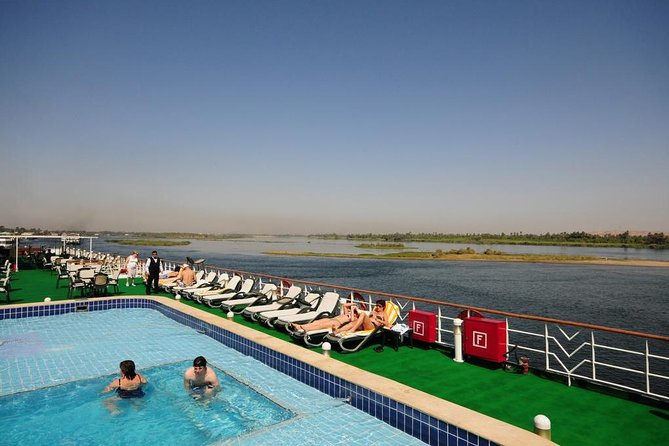
The West Bank visit is scheduled for the third day, followed by a return to the ship for afternoon tea and time by the swimming pool. That break is welcome. You can rest, cool off, and let the morning’s sites settle before the evening visits.
Luxor Temple after dark, then the vast halls of Karnak
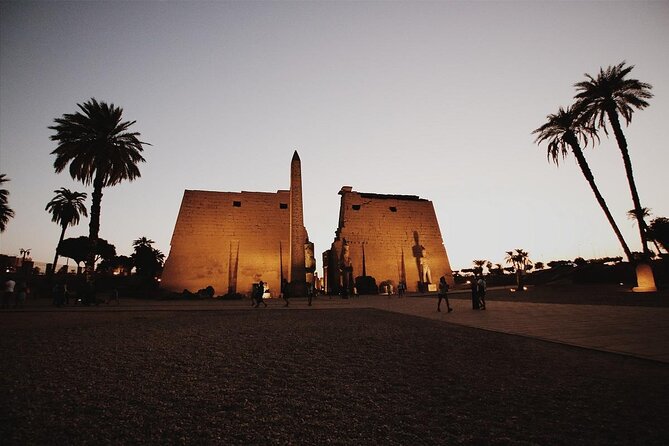
The program continues to Luxor Temple and Karnak, with about two hours allocated to each. Luxor Temple is especially striking because it sits within the modern city rather than far out in the desert. Its columns, statues, obelisks, and ceremonial spaces show how the ancient city connected royal power with religious worship.
Karnak is much larger and more complex. It grew over roughly 2,000 years, with successive rulers adding pylons, shrines, obelisks, sanctuaries, and avenues. The Avenue of Sphinxes and the Great Hypostyle Hall are among the major features named in the program.
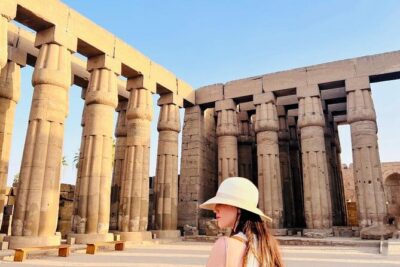
The Hypostyle Hall contains 134 colossal columns, with the tallest reaching about 70 feet. It covers roughly 5,356 square meters. Those numbers help, but they do not prepare you for the effect of standing among the columns and looking up at the carved capitals and surviving sections of roof.
Two hours at Karnak is enough for a guided overview, not a slow study of every corner. Listen to the guide’s route and keep your expectations realistic. This is a vast complex, and the final day packs a lot into a short period.
The evening schedule gives you an overnight stay in Luxor. Depending on the ship’s operating plan, Luxor Temple may be visited after sunset or during the final sightseeing period, but the supplied program does not promise a specific lighting schedule. Confirm the timing with your guide.
What the private format changes
This is a private activity, so only your own group takes part. That can make a real difference at temples. You can ask questions without holding up a large coach group, and your guide can adjust the explanation to your interests and pace within the fixed schedule.
The tour uses air-conditioned vehicles for ground transfers and provides door-to-door pickup and drop-off. That is valuable in Aswan and Luxor, where the distance between a ship, a hotel, and a monument may not be obvious from a map.
The cruise is best for someone who wants structure. You receive transport, entrance fees, meals, accommodation, and guided visits in one package. It is less suited to someone who wants to set their own temple hours or spend several unplanned days in Luxor.
The only direct praise available for the service points to friendly, helpful boat staff and strong guiding in Edfu and Luxor. That matches what I would value most on this route: clear explanations at the sites and staff who make the ship easy to use between excursions.
Who should book this Aswan to Luxor cruise?
I would choose this cruise if you are visiting Egypt for the first time and want the main Nile sights handled in a single plan. It also suits families, couples, and small private groups who prefer a guide and included transport over arranging each stop independently.
The three-night length works well for a short Egypt trip, but it does not leave much spare time. You will see many important sites, yet the pace is active and the sightseeing days are full. Travelers with limited mobility should note that the tour involves walking through temple grounds and archaeological areas, although the supplied information says most people can participate.
Before booking, confirm four details: the ship’s name, cabin category, exact pickup time, and which tombs or extra admissions are covered. Also set aside money for drinks, gratuities, and optional visits.
Should you book it?
Book this tour if you want a well-organized Nile route with the major temples, full-board meals, air-conditioned transfers, and an Egyptologist guide included. At $542.86 per person, the package offers solid value when you count the ship, tickets, transport, and three nights of accommodation together.
Skip it if you want a slow Luxor stay, independent temple visits, or a cruise with no fixed sightseeing timetable. For most first-time visitors who want to see Aswan, Kom Ombo, Edfu, and Luxor without constant planning, this is a practical and appealing way to follow the Nile north.
Free cancellation is available up to 24 hours before the experience begins. Changes or cancellations made later are not accepted for a refund.
FAQ
How long is the Nile cruise from Aswan to Luxor?
The experience lasts four days and includes three nights aboard the Nile cruise ship.
What meals are included?
Breakfast, lunch, and dinner are included for the three cruise nights. The meal plan begins with lunch on the first day and ends with breakfast on the final day. Drinks are not included.
Which historic sites are included?
The program includes the Aswan High Dam, Temple of Philae, Kom Ombo Temple, Edfu Temple, the Valley of the Kings, Temple of Hatshepsut, Colossi of Memnon, Luxor Temple, and Karnak Temple.
Is Abu Simbel included?
No. The Abu Simbel trip is an optional extra and is not included in the listed price.
Is this a private tour?
Yes. Only your own group takes part in the activity. Air-conditioned ground transport, pickup, and drop-off are provided.
What is not included in the price?
Drinks, gratuities, and attractions not listed in the program are not included. The Nubian village visit, hot-air balloon ride, and Abu Simbel trip are optional extras.
Just added in the Nile Valley
- Egypt 8 Days Cairo,Nile cruise,Luxor,Aswan from Cairo airport★ 5.0 · 79 reviews
- Private Tour: 7 Nights Pyramids & Nile Cruise +Flights from Cairo★ 4.5 · 157 reviews
- 8 Day Cairo Pyramids and Nile cruise and Alexandria All inclusive Private Tour★ 5.0 · 23 reviews
- 7 Days Egypt Tour Package to Cairo and Nile Cruise★ 5.0 · 62 reviews
- 6-Day Egypt Package, Nile Cruise from Aswan to Luxor by Flights★ 5.0 · 18 reviews
- Private 6-Days Egypt Tour Package with Nile Cruise by Flights★ 4.0 · 59 reviews
- Egypt in 9 Days from Saturday to Sunday including tours and Dahabeya Nile trip.★ 5.0 · 21 reviews
- From Cairo 4-Day Nile Cruise to Aswan by Flights& Hot Air Balloon★ 4.5 · 44 reviews
Nile Cruises, compared.
4-Days Nile Cruise From Aswan To Luxor including Abu Simbel and Hot Air Balloon
Read our review →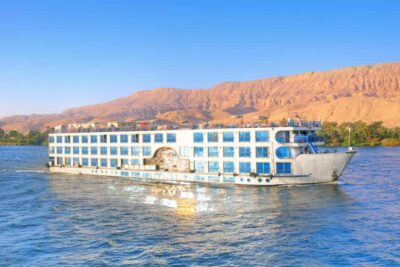
4-Day Nile Cruise from Aswan to Luxor with Guide
Read our review →Browse the lists this tour appears in